

Choose the tool for the question you need answered
Here is a quick way to decide: who will use the number, and what will they do with it? A seller can change an asking price next week. An executor may need a record of what the house was worth on a specific day years ago.
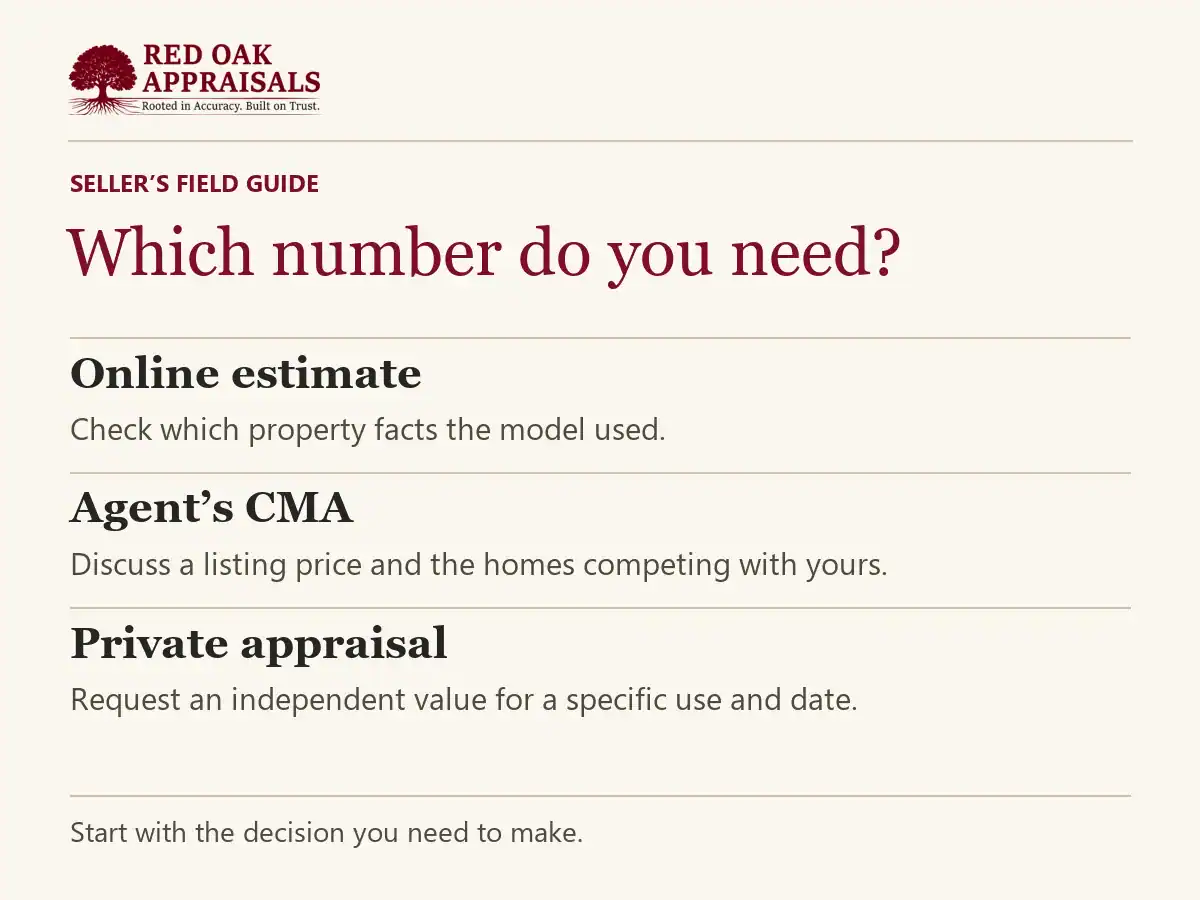
What an appraisal provides
Ask what you would hand to the person who needs the number. An agent can discuss an asking-price strategy. An appraiser can give an intended user a written value opinion for an agreed purpose and date.
Say an estate needs the value as of last March. The kitchen was remodeled in July. Keep the dates of the work and any earlier photos. They help the appraiser reconstruct the kitchen that buyers would have seen in March.
What a CMA provides
A real estate agent or broker prepares a comparative market analysis, or CMA, to help plan a listing. It considers competing homes and buyer activity to inform the asking price and marketing strategy. If your main question is how to bring the home to market, a real estate agent is a useful starting point.
You can take an appraisal to a listing appointment. Ask the agent which competing listings have appeared since the appraisal date, which have sold and how that changes the pricing strategy.
What an online estimate provides
Open the property details behind the online estimate. Does the site include the finished basement in the same figure as the upstairs rooms? Does it show a second garage that was removed? Write down one difference you can verify before comparing the dollar amounts.
An appraisal and home inspection answer different questions
A home inspection examines the property’s condition and systems. A survey, title review, environmental assessment and legal or tax advice answer other questions. The Consumer Financial Protection Bureau offers a plain-language explanation of the different roles of an appraisal and a home inspection.
About the examples: The figures and properties are invented to explain the method. They are not market data or recommended adjustment rates. Mortgage guidance applies to the relevant program only.
Why three reasonable numbers can disagree
An asking price reflects a selling strategy. An appraisal addresses a particular property interest and date. An automated estimate depends on its model and source data. Differences in those inputs can explain why the numbers disagree. The CFPB explains how dates, purposes and comparable data affect valuations.
Compare the evidence in four steps
- Match the date and property: check the address, interest appraised, condition and included spaces.
- Identify the decision: listing strategy, current private valuation or a value for a past event.
- Examine the support: which sales were used, what was verified and how important differences were handled.
- Resolve the largest conflict: ask about the specific missing renovation, incorrect area or unsuitable sale before debating the final number.
For appraisers: explain the disagreement without dismissing the other tool
For appraisers: give the reader one difference they can follow from a source to the analysis. If the model shows a finished basement and the home has an unfinished one, identify the source of each description and explain how you handled the discrepancy.
The Appraisal Foundation’s practicing-appraiser guidance on AI explains why analytical software does not replace professional judgment. Treat a model output as something to understand and evaluate, not independent verification of another model using the same records.
Continue with tracing an adjustment from evidence to conclusion.
Choose the next step
For a private appraisal, call 636-201-5260 or email redoakval@gmail.com with the address, reason, required date and who needs the report. If you need marketing advice or a detailed condition inspection, start with the professional who provides that service.